| 
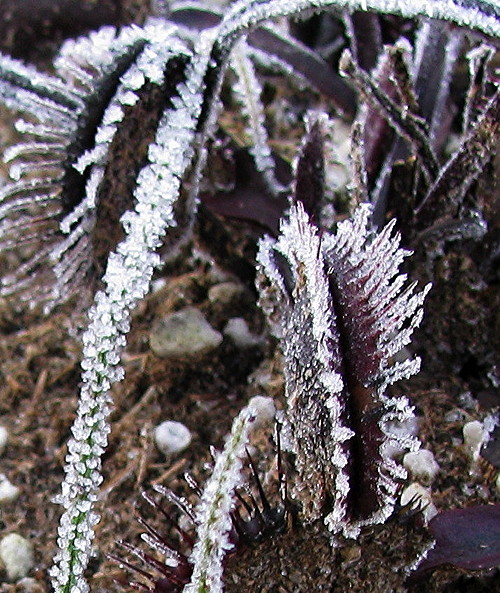
Sarracenia seedling a few
months old. The longest pitcher is about 2 cm.
|
Sarracenia are fairly easy to grow from seed if you have
patience. Each step in producing the seed, germinating it, and growing
the plants takes patience. It can take 4 to 6 years to go from a
just-pollinated flower to a mature, blooming plant. Don't even think
about how old you will be or what you will be doing in 5 years.
Just do it for the adventure. You never know for sure what you will
get nor what will happen to you.
Sarracenia seedlings make excellent terrarium plants.
For the first two years you can grow seedlings under lights without
dormancy. In fact, if you give them enough light, after two years
you will have a plant the size of plants three to four years old
plants grown outside with dormancy. If your plants get too big for
your terrarium and you don't have a place to grow them outside,
give them to someone else who does and start some more seeds.
Pollination
Sarracenia flowers usually appear in the spring slightly
ahead of or with the first pitchers. The very elaborate flowers do not self pollinate. In many areas, there aren't any pollinators
that know how to work the flowers or the plants bloom too early
for there to be any pollinators around. If you don't pollinate the
flowers yourself, it won't happen and you won't get any seed.
Sarracenia flowers are designed so that a pollinator
visiting a flower must brush past a stigma (the pollen receptive
part) to get into the chambered part of the flower where the nectar
and stamens (the pollen producing part) are located. The stigmas
are near the tips of the upside down umbrella-shaped style. Once
the pollinators push their way into the inner chamber, they have
a jolly time rolling in the pollen and slurping the nectar. To
get out pollinators have to push their way under a petal. This
avoids pollinating that flower with its own pollen. Some of the
pollen on the pollinators body rubs off on the stigmas of the next
flower they visit.
| Female Flower Parts
|
|
To see where you get the pollen to put on the stigmas, lift a
petal of the flower. Inside you will see the pollen-bearing stamens
hanging next to the ovary and piles of pollen on the style floor.
Use a fluffy paint brush to get the pollen off the stamens and
to pick up the pollen that is usually laying on the style. Watch
out for the nectar globules as they will gum-up your brush. You
can use this pollen immediately to pollinate the flower and other
flowers on the plant or on other plants. To save the pollen for
later, brush it onto a piece of aluminum foil, fold the foil to
make an envelope, and place in a freezer. It will last in the
freezer for a month or so. Since each species tends to bloom at
a slightly different time, saving pollen is necessary to make
certain hybrids.
Some Sarracenia species do not take well to being self
pollinated. To get good quality seed you need to cross pollinate flowers of two non-clones of the same species. Sarracenia flava is the one to be
careful about most if you want lots of seeds and healthy plants. The
S. flava var. atropurpurea and S. flava var.
rubricorpora are the most difficult. These plants tend to
have one flower per plant and there is less opportunity to self
pollinate and eliminate deleterious genes. When you do the unnatural
thing of selfing the flowers, all those bad genes get expressed.
Sarracenia rubra at the other extreme tends to have very
many flowers per plant in nature and selfing is not as much of a problem.

Sarracenia seeds over a 1 mm ruler.
The color differences are not diagnostic. Seed from the same
plant can range from purple to brown to tan. |
Now that you have finished playing "bumblebee", you get to wait
5 months to see if your pollinations were successful and you get
seed.

Sarracenia rubra seed pod with ripe seeds |
You can collect the seeds before the pods turn brown and split
to get a few month's head start with the seedlings. If your plants
bloom in April, you may be able to get viable seed from the pods
in mid August but it is best to wait until September. If the pods
start turning brown, pick them immediately so the seed won't be
lost when the pod splits open. Put the pods into a paper
envelope to dry completely then carefully split them open and
remove the seeds.
Germinating Seed
Sarracenia seed is rather odd. It has a waxy coating making
it hydrophobic. I suspect it is dispersed in nature by floating
on water. This also makes it difficult to germinate quickly. The
seed can't germinate until you get moisture past the wax and seed
coat into the embryo. You waited how many months to get the seed
and you want the plants NOW! Relax.
There are all sorts of claims about quick methods of germinating
Sarracenia seeds. DON'T WASTE YOUR TIME OR SEEDS. Yes,
you will get some germination but to get good germination you need
to use the tried and true methods.
If you live in an area where Sarracenia grow naturally
or where they could if there were appropriate habitats, you can
ignore all that follows and just plant your seeds outside in the fall in 15 cm (6 inch) or larger
pots filled with a peat/sand mix and let nature
takes it course. You should probably protect the seeds and seedlings
from heavy rain until the plants get established. Consider using the tenting method used at the Meadowview Biological Research Station. Make sure you use
rain, reverse osmosis, de-ionized, or distilled water if there is
even a moderate amount of dissolved solids (salt) in your tap water (Usually surface derived water is OK; well water is iffy. Check the water quality report from your water company or city.
Total dissolved solids below 100 ppm is best.)
A few words about soils for Sarracenia.
Sphagnum moss is generally recommended as the best medium
for Sarracenia. Sphagnum moss is hard to find, very
expensive, not harvested in a sustainable manner. Quite
often moss sold as sphagnum is actually a sheet moss that
can be toxic to Sarracenia.
Soil mixes with peat are quite adequate for Sarracenia.
In fact S. rubra, S. psittacina, S. rosea and most
hybrids prefer being in a peat mix. I grow S. psittacina
in pure peat. Keep in mind though, with a peat mix you need
to top water the plants and change the water in the trays
frequently. How often depends on your water quality, how often
you water your plants, and exactly which mix you use.
The most common peat mix is equal parts peat and silica
sand. The peat needs to be sphagnum peat which is decomposed
sphagnum
moss. The sand should be fairly coarse and about the same
size grains. Coarse, washed "play sand" can work
but it has a lot of small particles.
Horticultural sand and 16 mesh silica sand blasting sand
are best. Sand may need to be soaked for a while in purified
water to remove the
salts
in
them. The salt gets into the sand during processing
because water is sprayed on the material to reduce the dust.
Breathing silica dust from sand is
dangerous to your health.
Some members have great success using perlite instead of
sand in their soil mixes. For me it has been nothing
but disastrous. The difference seems to be their domestic
water is low enough in dissolved solids they can top water
their plants regularly from a garden hose. Breathing perlite dust is very
dangerous to your health. |
The tried and true way of germinating Sarracenia seed
is to cold stratify the seed for 4 weeks. Storing the seed dry
in the refrigerator isn't stratification. Stratification is storing
the seed in a cold and damp environment usually with natural materials
that may aid the process of convincing the seed it is time to
start growing. The easiest method is to refrigerate seeds in a
small plastic bag with a few strands of finely chopped sphagnum
moss dampened with purified water. Live sphagnum is the best choice. The moss should be wet enough
so that if you squeeze it you will see water but there shouldn't
be any free water in the bag. If you don't have live or dried sphagnum moss and must use peatmoss, get it very wet then squeeze it to remove most of the water and make sure there is plenty of air in the plastic bag. The seeds need air.
The seeds could die if the peatmoss is too wet. If the seeds are old you may want
to soak them for a day before you stratify them. Put the seeds
in a small dish of purified water and a touch of dish detergent
(by touch I mean touch the detergent dispenser and disperse the
detergent in the water with your fingers).
Another method is to
sow the seed directly in pots and store the whole pot in a plastic
bag. Stratifying seeds can be stored in a refrigerator, garage,
or other location that stays around refrigerator temperature and is out of the sun.
Or you can use a tenting method used at the Meadowview Biological Research Station. Seeds planted outside in unprotected pots have a tendency to wander into adjacent pots.
 |
Sarracenia seeds stratifying in finely chopped live sphagnum moss.
Whenever possible, grow your own sphagnum moss. Put it in the pots with your Sarracenia, in any extra pots you may have, grow it in trays under the benches in a greenhouse if you have one, grow it outside if you can. |
|

|
Sarracenia sprouts. Note the seed
still attached to one of the cotyledons (embryo leaves)
and that the first true leaves are miniature pitchers. |
Sow seed on finely chopped sphagnum moss or peat mix in conveniently
sized pots. If you stratified the seed in a plastic bag, spread
it over the medium in the pots with your planting spoon. Standard
8.5 cm (3 inch) pots work well. Don't bury the seed. If you have
it, use live sphagnum. Chopped live sphagnum works best for germinating
seeds. However live moss can over-grow the plants later so you have
to keep an eye on them and trim back the moss by plucking out the
growing tips or transplant the small plants to other media. If you
don't have live sphagnum, use chopped dried long fibered sphagnum
(chop it before adding water) or a peat mix. Place the seed about
5 mm apart and use a number of pots to keep from having all the
seed in one pot.

Sarracenia seedlings and yearlings in a terrarium. This
terrarium has mirrors around it to reflect light diagonally
so the pitchers get better light. It also makes it look
like you have twice as many plants! |

Max headroom is a major concern with Sarracenia in
terrariums. These three year old plants put on a tremendous
growth spurt. |
Put the pots with seeds in plastic bags under florescent lights
until the first signs of germination. If you leave 1 to 2 cm of
head space on the pot, you can use plastic wrap and a rubber band
instead of plastic bags. Don't put the bags in direct sun or too
close to the lights as you would end up with cooked sprouts. A
temperature
of 20° to 25°C (70° to 80°F) is ideal. The seeds
should germinate in 2 to 4 weeks.
After the seeds germinate the plastic wrap should be removed or
the pots removed from the bags. Put the pots into a terrarium with
some air circulation. Or if the weather is mild, just put them outside
in a sunny location with your other Sarracenia.
Growing Juvenile Plants
Juvenile Sarracenia can be raised in a terrarium under
lights for two to three years before they need to join the adults
and start the cycle of seasons. When the Sarracenia seedlings
have about 5 leaves, they can be transplanted into pots with the
plants spaced about 2 cm apart or 9 to a standard 8.5 cm (3 inch)
pot. If you use long fibered sphagnum, it should be chopped into
1 cm or shorter lengths so the plants can be transplanted later
without breaking the roots. The pots should be put into a terrarium
under 4 fluorescent bulbs or the equivalent. The lights should be
on for 16 to 18 hours per day and it is a good idea to line the
outside of the terrarium with aluminum foil or mirrors to maximize
the amount of light the plants get. As the plants grow too large
for the community pots, you may want to transplant the larger ones
individually into 5 cm (2 inch) pots.
If you have a greenhouse that stays between 15° to 32°C
(60° to 90°F) year round you can push your Sarracenia
there as well. At higher latitudes they may need some supplementary
lighting in the winter to keep them from going dormant. The plants
benefit from being bumped up into larger pots sooner. They can go
immediately individually into 5 cm (2 inch) pots and after a year
into 8.5 cm (3 inch) pots.
The tricky part of growing Sarracenia indoors or a greenhouse
is how and when to acclimate them to life outdoors. Too early in
the spring, the cold nights could trigger dormancy and halt their
growth for a few months. Too late in the spring or early summer,
the heat and intense sun could burn off all their foliage. Sarracenia
are very tough plants and they should recover quickly. But you put
all this effort into getting your plants full grown as quickly as
possible and don't want to blow it after so much effort.
Plants can be set back a year if the acclimatization goes wrong.
You can fertilize Sarracenia if you are careful. The
plants enjoy foliar feeding with foliar fertilizers such as Miracid and high nitrogen orchid fertilizers.
Make sure you use rain or purified water to dilute the fertilizer
and use half to a third the usual strength solution. With Miracid
that would be no more than 1 tsp per gallon. Don't put the fertilizer
in the traps. You can also fertilize the soil if your plants are grown outdoors or in a bright greenhouse.
Please see these pages for specific comments
on each species:
|