Drosophyllum lusitanicum,
commonly known as the dewy pine, is a popular plant among
collectors since it is the sole representative of its genus.
It is also significantly different from other carnivorous
plants in that it inhabits drier climates. Unfortunately,
this plant also has a bad reputation as being difficult to
grow and maintain. The main problem is that cultivation methods
used for other bog-dwelling carnivorous plants are lethal
for Drosophyllum. Specific challenges with cultivating Drosophyllum include:
slow germinating seeds, root disturbance is often deadly
and the plants are prone to root rot.
The first problem with this species is that the seed is
slow to germinate. We have had seeds germinate 9 months after
being planted. Peter D’Amato's book The Savage Garden
suggests seed scarification to speed the germination process.
Even with scarification, you should expect germination on
the month time scale. However, it has been our observation
that seed germination was the best (at ~65%) when the seed
produced in the early summer was stored dry in a refrigerator
and then planted outdoors in the fall without scarification
(temperature range ~ 40F to 60F, even photoperiod). The seeds
do not require stratification, but the better germination
rates in the fall suggest they may prefer cooler temperatures,
so additional germination experimentation is needed. Plant
the seeds on the surface of the soil mixture (see below)
without burying the seeds. Keep the seeds constantly moist
but not waterlogged. Peter D’Amato indicates that the
seedlings have an inhibitory effect on other seeds, thus
the plants (and seeds) should be well separated from each
other. While this may be possible, we have not observed this
in our plants; we have had seeds germinate in the pots of
established Drosophyllum plants on multiple occasions.
The second problem with Drosophyllum is that root
disturbance often kills the plant. Both Adrian Slack and
Peter D’Amato advise against transplanting Drosophyllum.
Peter D’Amato suggests germinating the seeds on damp
vermiculite and then transferring the seedlings to their
final growing pot immediately upon germination. While this
approach works, it results in a small seedling in a rather
large pot, which is not space efficient. Another strategy
is to germinate the seed in small peat pots filled with the
porous soil mix (see below). Poke a few holes in the peat
pot to make it rather porous as well. Once the plant has
reached approximately 5 cm in height, then plant the whole
peat pot into the final growing pot. The roots will spread
through the holes in the peat pots and the peat pot will
eventually decay away. Thus, root disturbance is eliminated
when potting the seedlings into the larger final growing
pot. Be sure to use a large pot (10” to 12” in
diameter) to account for future growth since you should not
transplant the Drosophyllum plant again.
The last major problem is that Drosophyllum is particularly
susceptible to root rot, thus it must be kept considerably
drier than other carnivorous plants. It should never be grown
on the tray system like other carnivorous plants. The soil
mixture for Drosophyllum should be very airy and fast
draining (e.g. 25% each of pumice, perlite, sand and peat)
to reduce the chance of root rot. Additionally, we prefer
to use terra cotta pots for this species due to their porous
nature, which reduces the chances of the soil mixture getting
too wet. Ironically, the plants should never be allowed to
completely dry out. The pot should be watered every 2-3 days
in warm climates, but do not spray the foliage during watering.
Highly humid and warm environments also promote rot in this
species; we have lost large plants in our greenhouses to
root rot. Plants grown outdoors year around in Davis, California
(a Mediterranean–type climate) faired far better than
the ones grown in the greenhouses. The cool and moist winter
does not seem to bother the plants.
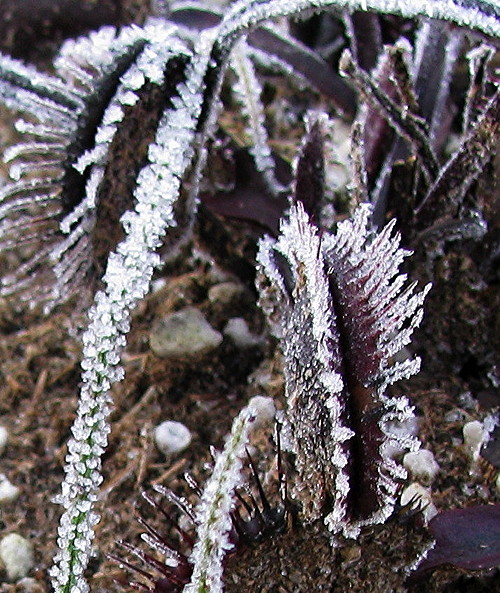
Drosophyllum grows best in full sun to mostly sunny
conditions even in warm climates. The plants seem to be able
to take light frosts according to Peter D’Amato and
our own observations. It may be possible to grow Drosophyllum indoors,
but it will require intense sunlight (south-facing window).
It may also like to be moved outdoors for the winter.
Tom Cahill
For more information please see:
Tilbrooke, R.D. (1988) Scape and Axil Cuttings of Drosophyllum. Carniv. Pl. Newslett. 17(4):106-107 (
)
Haberlandt, Gottlieb (from Sinnesorgane Im Pflanzenreich, Trans. By Carla R. Powell) (1982) Insectivores: Drosera and Drosophyllum. Carniv. Pl. Newslett. 11(3):66-73 (
)
Degreef, John D. (1989) Early history Drosera and Drosophyllum. Carniv. Pl. Newslett. 18(3):86-89 (
) |

Drosophyllum lusitanicum young
plants growing in a community pot. (photo: Barry Rice, sarracenia.com)
|