Growing Dionaea muscipula
 About the Seed Bank
 On-line Seed List
 Germination Guide
 Seed Use Rules
 Frequent Questions
 Donating Seed
 What's New
 
 ICPS Home Page


Dionaea muscipula sprout. Note the non-carnivorous cotyledon leaves with the seed still attached. The first true leaves have traps.


This is the same seedling a few weeks later.

The seeds were planted a little close together.

Dionaea muscipula is found naturally in the coastal plain of south eastern North Carolina and north eastern South Carolina. The plant is surprisingly adaptable considering its narrow distribution in the wild. As long as you are able to give it a rest in the winter, the small plant makes an excellent addition to any terrarium or sunny window sill.

The main requirements for growing Dionaea muscipula are (1) the plant needs lots of light. Give it full sun if you can. (2) During the summer, the pot with the plant must always be sitting in pure water. Use distilled, reverse osmosis, or clean rain water if your tap water has a total dissolved solids higher than 90 ppm. (3) To survive long term, the plant must have a winter. Winters along the Carolina coast are relatively mild and dry. Without seasonal clues and at least some dormancy, Dionaea muscipula will not survive long term. If you grow your plants indoors, and if the plant has been growing for over 9 months and then stops growing, consider trimming off all the dead leaves, lightly dusting the plant with cinnamon (to combat mold) and put it in a plastic bag in upper part of the door of your refrigerator (the warmest part) for 3 weeks. If it is winter, placing the plant in a cold window should also be adequate. For more detailed growing instructions, please see the Check List for Growing Dionaea muscipula.

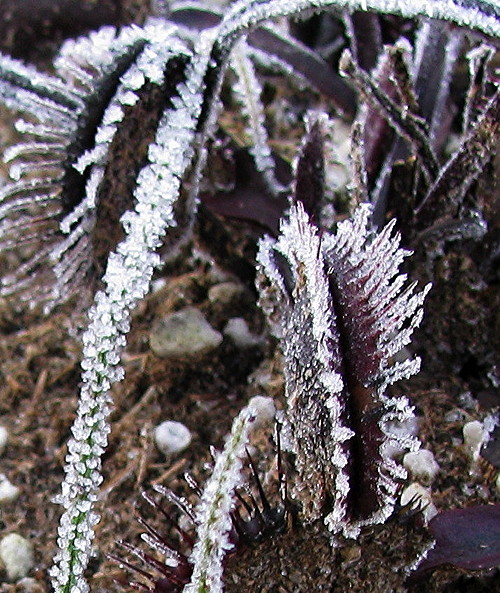
If you live in USDA zones 7 to 9 there is no excuse not to keep as many pots of Dionaea as you can manage outside year round. In colder areas or during extreme conditions, move the plants into an unheated garage or cover with snow. But in general, the plants survive quite well being frozen solid for a week as long as they are fully dormant and protected from drying out.

Dionaea muscipula isn't very picky about soil. It grows well in pure Sphagnum moss (live or from dried), pure Sphagnum peat, and the standard 1:1 peat:sand "CP mix". I have found 4:1 peat:sand in tall pots (soil surface at least 5 cm (2 inches) above the water level) to work best. Avoid perlite, pumice, and other potentially salty soil components.

Sow seeds of Dionaea muscipula on the surface of your medium of choice. About 3 mm of washed quartz sand over CP mix works well as does a layer of finely chopped live sphagnum moss over CP mix. The live sphagnum can overgrow the plants so keep a close eye on the seedlings if you use it. Finely chopped long fibered sphagnum over CP mix or CP mix alone also work well germinating seeds. The main problem is the nutrients in peat encourage the growth of cyanobacteria (AKA bluegreen algae) that can overgrow the small, very slow growing seedlings. However the nutrients in the peat, what small amount there is, give the small seedlings a boost. The soil should be saturated with pure water.

What you do after sowing the seeds depends on what works best for you. Everyone has their own preferred routine. I lightly spray the seeds with water and put the pots in plastic zip-lock bags under but not too close to florescent lights. A temperature between 20°C to 25°C (70°F to 80°F) works best. After the seedlings get a few true leaves (the ones with traps), I remove the pots from the plastic bags and move them to bright terrarium or greenhouse.

The seedlings are very slow growing. Have patience. DO NOT fertilize them unless you don't care if you kill the plants. Dionaea seedlings will tend to grow for about 4 months then stop growing.  They are expecting winter to start a that point.  They can be tricked by transplanting into new media. They will grow about 6 months and stop growing again.  Yep, time for winter again.  The plants get smarter as they get older and may or may not respond to a repotting.  If you are lucky the plants are now about 1 cm across.  Most people at this point give up and go to a local nursery to get a full grown plant. If you want to continue with the seedlings and it is winter, put them outside or in a cold window. If it is summer it may become a standoff of wills to see if you can get the plants to start growing again. Or try the refrigerator trick mentioned above.

As much as possible, try to grow your plants outside. They will grow best in full sun if you live in an area that is humid or cool in the summer. If where you live is hot and dry, full morning sun and then part shade is appreciated. During the winter, if your temperatures don't stay below freezing for more than a week at a time, keep the plants outside fully exposed to the rain and snow. They will survive being frozen solid for a week if they are fully dormant. Do not let them dry out as the biggest danger is freeze-drying. Where it gets tricky is when the plants are being overly protected and then get frozen solid for weeks at a time. To be safe in very cold climates it may be best to put the precious plants in a south facing window of a garage. You can also put the plants in a cold window in the house and they probably be just fine there too.

Dionaea is very picky about it's food.  It only likes live insects or spiders. The food needs to be alive to provide the proper stimulation for the leaf to close fully and begin digestion. Outside, the plants will tend to catch all the insects they need although it won't hurt to feed it live insects or spiders by hand. Larger plants will benefit from misting with a foliar fertilizer but fertilizer on or in the soil can do much more harm than good.


Dionaea muscipula has seasonal leaf forms. In the spring and fall, the leaves have short wide petioles and hug the ground like the plants in the picture above. During the late spring as the flower stalks emerge, the plants tend to put out upright leaves with long narrow petioles.
Snow


This is how healthy Dionaea plants look at least 3 month of the year while they are dormant. Some growers repot their plants every spring just as they start growing. These were repotted a week after this picture was taken.

At left are over wintering Dionaea and Sarracenia plants.


©International Carnivorous Plant Society      
www.carnivorousplants.org

Google Custom Search

This page is maintained by John Brittnacher,