Growing Drosera rotundifolia
 About the Seed Bank
 On-line Seed List
 Germination Guide
 Seed Use Rules
 Frequent Questions
 Donating Seed
 What's New
 
 ICPS Home Page
 

Drosera rotundifolia from Austria. It tolerates warmer temperatures than the California plants. These plants are about 3 cm across.

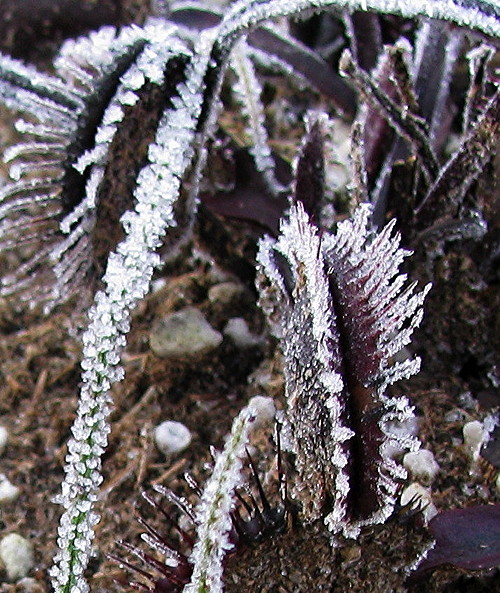
Drosera rotundifolia winter resting bud or hybernacula. This is what this species looks like a third to half of the year. Keep plants cool and just damp while in this state.

Drosera rotundifolia is found in sphagnum bogs in North America, Europe, and northern Asia. It requires a definite winter season to survive long term and likes cool temperatures. If you live within its natural range, you should consider growing Drosera rotundifolia from your climate zone outside year round. If you want to grow your plants in a terrarium, put them outside or some other cool place during the winter or grow Drosera rotundifolia 'Charles Darwin' as described below.

Seeds of Drosera rotundifolia need a "winter" to germinate. For plants to be grown outside or in a greenhouse, it is important to start them at the appropriate season: winter. The usual way to give the seeds a winter is to give them 4 weeks of damp cold stratification. You can put pots planted with the seeds in the refrigerator for 4 weeks. You can put the seeds in a small plastic bag with damp peat or finely chopped sphagnum moss in the refrigerator for 4 weeks. Sphagnum usually works better than peat because if the peat is wet instead of damp, the seeds may not survive. After 4 weeks of stratification, carefully spread the seeds and moss over the surface of the soil in a pot and mist with water. Or you can be put pots planted with seed outside protected from rain or in the garage in the late winter when it is refrigerator temperature for a month and allow the seeds to sprout naturally when the weather warms.

No matter how you handle stratification, the seeds should not be buried when you want them to germinate. A pot with a 50:50 mix of peat and sand usually works well. Also consider a mix of chopped sphagnum and sand as D. rotundifolia is commonly found growing naturally in live sphagnum. The plants grow best in live sphagnum but the moss tends to overgrow them in normal domestic conditions. D. rotundifolia likes short pots to be close to the water level and to be very wet when growing.

Dormancy can be problem when growing D. rotundifolia. Many populations of this species spend half the year or more dormant. When you grow them in a greenhouse or terrarium, sometimes it seems if you sneeze near your plants they will go dormant. Then they stay dormant for months until they get the right clues or they rot. During dormancy it helps if they are kept cool and only damp unless of course you grow them outside. Outside it is best to let them do what comes naturally under natural conditions.

Drosera rotundifolia 'Charles Darwin' is a selection of this species produced by Ivan Snyder. Ivan crossed plants from different California locations and selected plants with seed that will germinate without stratification. Unlike the unselected parents, the plants grow very well in terrariums year round. Under constant light period and warm conditions they can grow for a couple of years without forming hybernacula. If they do form hybernacula, they "break dormancy" after a short period of time without special treatment.


Drosera rotundifolia
in Plumas County, California. Note it is not growing in sphagnum moss but it is growing right at the water level.


Drosera rotundifolia
seed next to a 1 mm grid


©International Carnivorous Plant Society      
www.carnivorousplants.org

Google Custom Search

This page is maintained by John Brittnacher,