Growing Drosera filiformis
 About the Seed Bank
 On-line Seed List
 Germination Guide
 Seed Use Rules
 Frequent Questions
 Donating Seed
 What's New
 
 ICPS Home Page
 

Drosera filiformis var. filiformis is the smaller and more delicate variety.

Drosera filiformis flower. This just happens to be Drosera filiformis 'California Sunset', a hybrid between D. filiformis var. filiformis and D. filiformis var. tracyi. It must be reproduced by leaf cuttings as the seeds don't breed true.

Drosera filiformis has two taxonomically recognized varieties. Drosera filiformis var. filiformis is found on the east coast of the USA and common in New Jersey bogs. Drosera filiformis var. tracyi is found in southern Georgia, northern Florida and the gulf coastal areas of Alabama and Mississippi.

There are additional varieties of Drosera filiformis in cultivation such as the "Florida All Red" form of D. filiformis var. filiformis that does not require winter dormancy and makes an excellent terrarium plant. Also from the Florida panhandle is a "giant" form of D. filiformis var. filiformis that is larger than the New Jersey form but smaller than D. filiformis var. tracyi. This has been distributed as D. filiformis var. filiformis "Florida" and D. filiformis "Florida Red". It should not be confused with the "Florida All Red" form as it forms hybernacula and requires a cool dormancy.

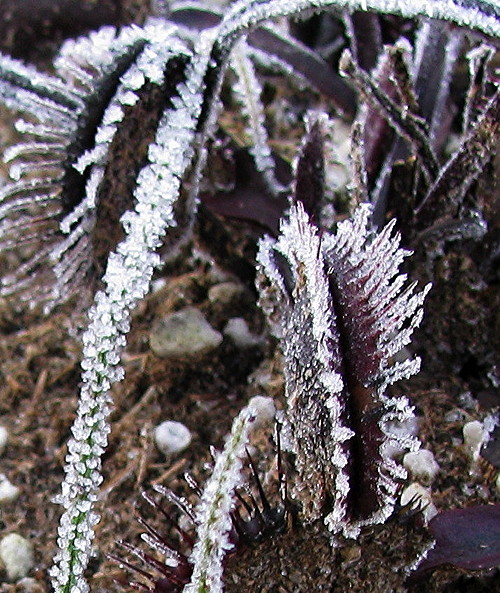
Drosera filiformis generally requires a definite winter season to survive long term. You should consider growing them outside year round if you live within their natural range. D. filiformis var. tracyi is rather large for a terrarium but D. filiformis var. filiformis may do well in one with very bright lights. If the plants go dormant and are kept too warm or too wet then the hibernacula will rot. This is especially a problem in the spring after the weather has warmed up but the plants have not started growing.

If you want to grow D. filiformis in a terrarium, it is best to grow the D. filiformis var. filiformis "Florida All Red" form. The seeds germinate without stratification and most of the plants don't go dormant. This plant may be grown outdoors in summer but needs to be in a warm greenhouse or other warm location during the winter if they don't form hybernacula. Select the plants that don't form hybernacula for your terrarium and grow the ones that do outside with your other D. filiformis. In a terrarium the "Florida All Red" form won't develop the deep red color it would in full sun outdoors. This plant does well in 100% peat and kept wetter than other D. filiformis when growing.

Seeds of D. filiformis need a "winter" to germinate. The usual way to do this is to give the seeds a few weeks of damp cold stratification. You can put pots planted with the seeds in the refrigerator for 4 weeks. An alternative is to put the seeds in a small plastic bag with damp peat or finely chopped sphagnum moss in the refrigerator. The seeds and moss can be carefully spread over the surface of the soil in a pot after stratification. Or you can be put pots planted with seed outside in the early spring and allow the seeds to sprout naturally.

No matter how you handle stratification, the seeds should not be buried when you want them to germinate. A pot with a 50:50 mix of peat and sand usually works well. D. filiformis likes large tall pots and can rot if the surface of the soil is too wet.


Drosera filiformis
var. tracyi in a 8 cm pot.

Drosera filiformis var. tracyi. Be prepared to be covered in slime when working with this species.


©International Carnivorous Plant Society      
www.carnivorousplants.org

Google Custom Search

This page is maintained by John Brittnacher,