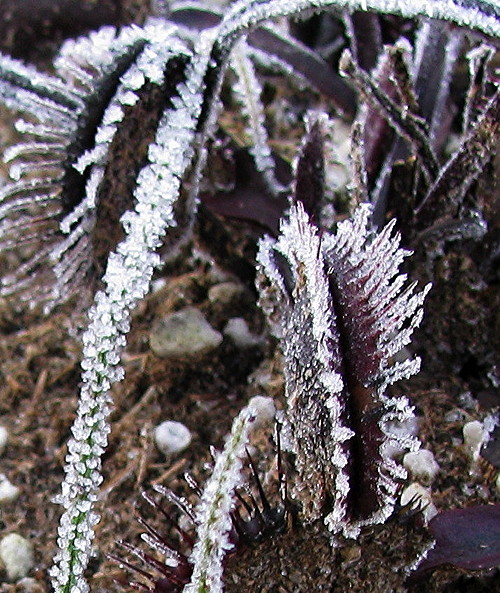
Tuberous Drosera are native to southern
Australia, Tasmania, and New Zealand. A few species like Drosera
peltata, and D. macrantha are
widespread but most are narrowly endemic to the state of
Western Australia. Tuberous Drosera live in areas
where winters are mild and rainy while summers are hot and
dry. The tubers sprout in early fall and begin vigorous growth
with the first rains. By late spring the plants have bloomed
and they die back to the underground tubers. The tubers over-summer
in warm barely damp soil.
Most tuberous Drosera are quite challenging to grow
unless you can provide their exact requirements. Drosera
peltata and D. stolonifera are
the most forgiving of adverse conditions and recommended
for beginners. As
long as the plants are kept cool and get lots of light, they
are very tough and easy
to grow. Most can take light frost. But temperatures above
25°C ( 78°F ) can cause them to die back and will
kill seedlings. If the plants have not built up enough nutrients
in the tuber to recover from the warm temperatures, the plants
are history.
Most tuberous Drosera do NOT make good terrarium plants.
If your house is cool enough during the winter, you could
rotate them into a large terrarium or grow them in a very
sunny window or under bright lights. However, you usually
either need to have a cold greenhouse if you live in cold
winter climate or if you live in a so called Mediterranean
climate you should grow tuberous Drosera outside all
year.
The tuberous Drosera seed must be planted in summer
or early fall since these species are winter growing. The
seed of most species will not germinate unless they have
experienced a period of warm or hot stratification as would
be experienced in summer. In the northern hemisphere this
means you must plant the seeds
by
the first
week of
August
(down under that would be February). The soil surface
needs to be kept damp during stratification. Drosera peltata and D.
macrantha will germinate if planted by the first week
of September (March in the southern hemisphere). Cold stratification
such
as
is used for Sarracenia and temperate Drosera is
NOT effective with tuberous Drosera. The seeds appear
to require cycling temperatures, temperature transitions,
and/or light queues to germinate. Expect the seeds to start
germinating in October and November (April and May in the
southern hemisphere). Seeds
planted late may germinate in the spring. Depending on your
growing conditions this will likely end in tears as the temperatures
could get too warm and the seedlings not live long enough
to make tubers.
Some tuberous Drosera species with hard seeds germinate
better if they are scarified before planting. These
species include D.
stolonifera ssp. stolonifera and
D. gigantea. Please see the page on Drosera seed
scarification for more information.
Tuberous Drosera require very deep pots and can not
be transplanted when growing because their roots are very
long and very fragile. Use 16 cm deep nursery #1 ("gallon")
pots to start seeds. A 1:2 mix of peat and sand with some
sphagnum moss in the bottom blocking the drainage holes works
well. Let the pots sit in about 2 cm of water. In mild winter
areas you may leave the pots outside and let nature takes
its course. In other areas you may start the seeds in a greenhouse
that allows the temperature to get down to a few degrees
above freezing at night. The perfect location is in the trays
with your Sarracenia plants although it is probably
best to protect the pots from rain and top watering as the
rain could wash out the seeds and encourage moss, liverworts,
and other weeds.
If the seeds don't germinate the first winter, don't throw
out the pot! Let it dry out during the summer and try again
the next winter. These plants require some patience.
After the seeds germinate, the challenge is to give them
enough light at cool temperatures to produce tubers sufficiently
large to get the plants going again the next winter. Most
species appreciate a foliar feeding of half strength Miracid
every two to three weeks. Only mist the leaves; don't fertilize
the soil. Do not force the plants to go dormant. This is
especially important for seedlings. If there is a heat spell
in the spring, put them in a cool location to delay dormancy.
When the plants do die back, let the pots dry out. For most
species you can let the pots get completely dry if they are
stored in a humid location out of the sun. Drosera gigantea and D.
sulfurea should never be allowed to dry out completely.
A technique for storing the pots with tubers over the summer
is to allow the soil to become just damp and then put the
pots in plastic bags or in a terrarium in a shady location
or under a greenhouse bench. A terrarium with gravel and
some water in the bottom works best as it is easy to keep
an eye on the pots and to check for new growth in the fall.
The only time you can transplant tuberous Drosera is
when they are dormant. If you are getting too many plants
in a pot, carefully dig up some of the tubers a month after
they die back and put them in new pots at the same depth
they were originally at in the old pots. They are usually
5 to 10 cm deep. Don't throw out the soil in the top 10 cm
of the pot unless you also want to throw away small tubers.
Don't wait until the fall to do the transplanting as many
species try to get a jump on winter by sending up a sprout
to just below the soil surface in late summer. Do enjoy these
wonderful ephemeral plants!

Many stalk forming tuberous species produce rosettes as seedlings and when
they first emerge in the fall from tubers. This is Drosera peltata. |

Drosera stolonifera is another
species that forms rosettes for a few weeks or months
before it bolts. |

After a few months for seedlings or a few weeks for plants with tubers,
the main stalk will appear. This isDrosera petlata ssp. auriculata from a tuber. |

D. peltata leaves
and flower buds. |

Tubers may be stored in plastic zip-lock
bags in a dark location. Plant them with the "eye" up. You
may find it easier to maintain mature plants if the
top 3 cm of the soil is pure sand. |
|

Drosera peltata from Dubbo, NSW, Australia.

Drosera petlata ssp. auriculata.
These plants are 25 cm tall.

Drosera petlata ssp. auriculata up
close.

Drosera stolonifera ssp. rupicola tubers dug up too early. If you have lots of them it is fun and interesting to dig them early and watch the tubers form. Tuberous Drosera have thick roots while growing and the tubers are formed after the top and leaves die back and while the roots shrivel.
|