|
Cephalotus follicularis is a popular plant among collectors for many
reasons. Its small size and intricate pitchers make it a great
addition to any terrarium or sunny windowsill. Evolutionarily,
Cephalous is placed in a separate family and thus has no close connections
with other carnivorous plant taxa. Its remote placement makes it
desirable for institutions and people trying to collect representative
members of the diverse carnivorous plants.
Cephalotus can be a tricky plant to cultivate, but the
problems are easily solved if the plant is given a little special attention.
The main cause of “sudden Cephalotus death syndrome” (which
is rapid plant collapse) appears to be root rot. Unlike many other carnivorous
plants, Cephalotus does not like to be grown in trays of water as with
other genera such as Sarracenia, Utricularia and many Drosera.
The continually damp conditions appear to make the plant prone to rot.
Unfortunately,
Cephalotus does not show any outward symptoms of rot or distress
until it is too late and then the plant collapse occurs quickly.
We have conducted experiments growing Cephalotus on the tray
system and on drip irrigation where the plant is not sitting in water
(n = 4 side-by-side pairs). The tests showed that none of the plants
on drip irrigation died while three of the four plants on the tray system
died over the course of a year. All of the plants lost at the UCDavis
Botanical Conservatory over the last 3 years were on the tray system. Conversely,
we have not lost a single plant on drip irrigation. Therefore,
we recommend that Cephalotus be grown on drip irrigation or in
single trays that are allowed to dry out between waterings so they are
not inundated with water for extended periods of time.
Growers of Cephalotus all have their favorite soil recipe for the plants
so there is no real consensus about what the “ideal” soil
mixture should be. We have found that 75% sand/ 25% peat appears
to work well for our plants at the Conservatory. This mix is rather
porous and readily drains water, thus reducing the chance of root rot. Other
mixes that contained either pumice or perlite were also acceptable. I
also personally like to add a layer (¼ to ½ an inch) of pure
sand on the top of the soil. This keeps the crown of the plant
a little dryer and helps retard the growth of moss.
Cephalotus grow best and are the most colorful with a lot of light. South
facing windowsills are the best for them, but east and west will sometimes
work. The plants grow well in both greenhouses and in terrariums. They
can even survive outdoors in the intense summer sun and heat of Davis,
although the plants were considerably smaller than the ones grown in
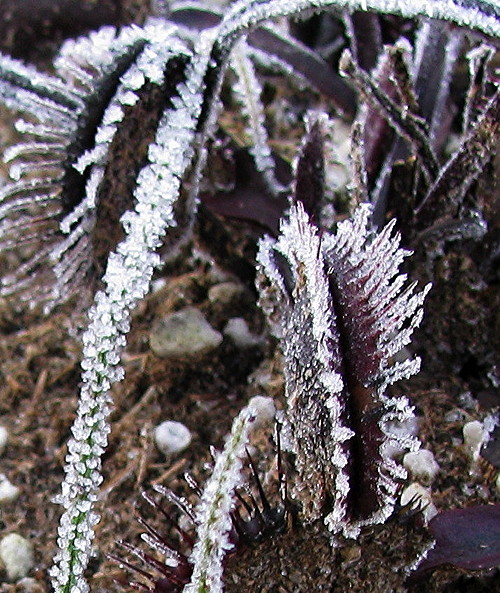
the greenhouses. The plants also can withstand light frosts with
no damage.
Propagation of Cephalotus
Cephalotus can be propagated by several means, namely seed, leaf /pitcher cuttings,
crown divisions and root cuttings. Unfortunately, all of these approaches are
rather slow to produce large plants, although the crown and leaf cuttings are
certainly faster than by seed.
The first
approach is by seed. This is difficult in two aspects. First, Cephalotus seed
is hard to obtain, although it sometimes shows up in the Seed Bank. Even
when it does show up, it is often on the “seed donor only” list
(i.e. people that have donated enough seed to have a seed credit with
the bank). The
second problem with propagation by seed is that it is a very SLOW method;
you will need a lot of patience! Once you get your Cephalotus seed,
you should plant it immediately. Finely chopped sphagnum moss works
well as a seed germination substrate. Place the seeds on the surface
of the substrate and do not bury them. Water the seeds well and
then put the pot into a sealed plastic bag and cold stratify the seeds
for 8 weeks in the refrigerator. Once the
stratification is over, remove the pot from the refrigerator and put
it in an area with bright, diffuse light but no direct sun. Leave
the pot in the plastic bag. With a little luck, germination should
occur after several weeks and although it can take months. The
plants are very small to start, so I leave the pot in the bag for a long
time while the plantlets grow. Since
the plants are tiny, they are easily overgrown by moss, so keep an eye
on the moss and make sure it does not overgrow the Cephalotus seedlings--it
is not unusual to transplant them to new media several times. When
the plants are big enough to safely transplant, then start to open the
plastic bag a little at a time over the course of a few days to let the
plantlets adjust to the new lower humidity levels. After transplanting
the Cephalotus seedlings, the plants should be kept in a propagation
terrarium or other place with high humidity until the get large enough
(~2.5 cm across) to transition to their final growing place. You
can expect to get a mature plant in 3 to 5 years depending on conditions.
A quick little experiment was conducted with fresh seed. There were three treatments: no stratification, 4 week stratification and 8 week stratification. The seeds (18 per treatment) were planted in April and they were germinated on sphagnum moss in 3" square pots. After the stratification time, the pots were moved to a greenhouse and put in partly shady conditions. After 5 months, only 4 seeds germinated and they were all in the "8 week stratification" treatment. However, by November (7 months after start of experiment), considerably more seeds germinated. The results from the no stratification, 4 week stratification and 8 week stratification were 8, 4 and 9 seedlings (per 18 seeds planted) in each treatment. Most of the germinations occurred during the fall time, so the time of year may be more important than the stratification time. However, the results confirm the notion that stratification is either beneficial or has no effect. Also, the seedlings that germinated earlier were the largest seedlings at the end of the experiment, thus it is beneficial to get the seedlings going as fast as possible.
|

Pitcher cutting. Notice a piece of the stem. This can be rough on your
plants.

Leaf / pitcher cuttings and a crown divsion in pots
in plastic bags. |
The
second approach for propagating Cephalotus is leaf/pitcher cuttings. Both
leaves and pitchers can be used, although I personally use pitchers more
often since many of our clones produce small leaves. The approach
is the same with both leaves and pitchers. Select and remove newly-developed
leaves or pitchers from the plant. Older leaves do not seem to
take as well. Remove
the leaf where the petiole adjoins the crown of the plant by tugging
the leaf downwards. Tweezers or forceps are useful in delicately
removing the leaves. Alternatively, the parent plant can be un-potted
and then the leaves removed. The new plantlets will form at the
base of the petiole, so it is important to get the base of the petiole
intact. The presence
of some steam tissue may help in the formation of the plantlet. Once
the leaves/pitchers are removed, then lay them face-up on a 50:50 mix
of peat:sand and bury the petiole such that it is just below the soil
surface. Do
not cover the leave blade or pitcher to any extent. Water the leaf
cuttings well and place the pot in a sealed plastic bag. The pot
should be moved to a location with bright, indirect light. Leaf/pitcher
cutting can form plantlets in as little as one month or as long as 9
months, so be prepared to wait for a while. The pitcher cuttings
will often close as a result of water stress, so don’t be surprised
if this occurs. So long
as the leaf/pitcher remains green, then there is a chance that the cutting
will take. Once the plantlet is formed, it will develop fairly
rapidly and can be transitioned out of the bag soon after emerging. I
have found that pitcher cuttings are a very reliable method for Cephalotus propagation with a success rate of 75-90%. This is the dominant
propagation method we use at the Botanical Conservatory.
The third propagation approach is division or crown cuttings. Cephalotus often develop multiple growing points that are connected to the root
system. Ideally, each crown should have its own roots when it is
removed (i.e. a division). However, the crowns often do not have
their own roots, so you cut through the rhizome and obtain a crown with
pitchers but no roots. Always leave the largest 1 to 2 crowns on
the parent plant. Even small crowns can be removed and rooted. Once
a crown has been removed, then it is planted in a 50:50 peat:sand mix
and watered well. The cuttings are then put in a sealed plastic
bag and treated like leaf cuttings. Most crowns will have formed
enough roots after 2-3 months that they can be removed from the plastic
bag to a high-humidity terrarium. This approach has a couple advantages. The
first advantage is that the success rate for crown cuttings is very high
(90-100%). The second advantage is that some Cephalotus develop
many small crowns that crowd each other. This helps to thin-out
the plant so the remaining crowns can grow larger and make larger pitcher. Lastly,
this is a vegetative method that is useful for generating popular clones
such as the “giant” form of Cephalotus.
-- Tom Cahill
|