Drosera rotundifolia from Austria. It tolerates warmer temperatures than the
California plants. These plants are about 3 cm across.

Drosera intermedia from North Carolina. The plants are about 7 cm across.
They are growing in a greenhouse. Outdoors in full sun they can turn a maroon color.

Drosera intermedia.

Drosera anglica growing outside in an 8 cm pot.

Drosera anglica CAxHI, a horticultural hybrid between the California and Hawaii forms of D. anglica.

Drosera intermedia has cold temperate and tropical varieties. This tropical form is from Cuba and it should be grown like other subtropical Drosera.
The plants are about 3 cm across. They are growing in pure
peat with a 1 cm mulch of sand. The sand helps cut
down on cyanobacteria and fungus gnats.
There are four species of cold temperate Drosera found in the northern hemisphere. Drosera linearis is a hard-core cold temperate plant and is difficult to grow where winters are milder than USDA zone 7. Drosera rotundifolia and Drosera anglica range further south in the wild and can be grown easily outdoors in zone 9 and colder. In the wild Drosera intermedia is found in warm temperate and subtropical habitats as well as cold temperate. The plants found in the USA, Canada, and Europe form hybernacula and are considered temperate. It is a good idea to choose plants from similar climate zones as your own and grow them outside.
Drosera linearis is the most temperate and difficult of these species to grow. It is found in marl fens in the Great Lakes region and Canadian Maritime provinces. Marl is an alkaline soil consisting of clay and lime. In the fens the plants will grow in this soil or in a thin layer of peat over the soil covered with about a cm of water. No other Drosera are found under these conditions although other species are found growing nearby in sphagnum moss. The major difficulty growing the plant is that it expects to be dormant about nine months of the year. In milder climates the plant goes in and out of dormancy, sometimes at inappropriate times, causing the plants to decline. The good news is in cultivation the plant grows better in pure peat and peat/sand mixes than it does in a marl-like soil mix.
Drosera rotundifolia is found in sphagnum bogs in
North America, Europe, and northern Asia. It requires a definite
winter season to survive long term and plants from most locations like cool temperatures. If you live within its natural range,
you should consider growing Drosera rotundifolia from your climate zone outside
year round. It can be tricky growing in a greenhouse or a terrarium because the plant expects seasonal cues and expects to spend six months of the year in dormancy.
Drosera rotundifolia 'Charles Darwin' is a selection
of this species produced by Ivan Snyder. Ivan crossed
plants from different California locations and selected
plants with seed that will germinate without stratification.
Unlike the unselected parents, the plants grow very well
in terrariums year round. Under constant light period
and warm conditions they can grow for a couple of years without forming hybernacula. If they do form hybernacula, they "break dormancy" after a short period of time without special treatment. It is hard to find this plant because it tends not to bloom without seasonal light cues but if given the seasonal cues will go dormant but not dormant enough to survive real winter conditions.
Drosera anglica is found in sphagnum bogs in North America, Europe, northern Asia, and Hawaii.
Except for the Hawaii form, this species is commonly found growing with D. rotundifolia. It requires a definite
winter season to survive long term and likes cool temperatures. Expect it to be dormant 6 months of the year.
The Hawaiian Drosera anglica is essentially a cold tropical plant. It grows well and blooms in a terrarium or greenhouse. The horticultural hybrid between the California and Hawaii Drosera anglica also makes a great terrarium plant.
Drosera intermedia is found in shallow water in
bogs and seeps of eastern North America, Europe, and along the bird Atlantic Flyway across the Caribbean and into South America. The North American and European
varieties require a definite winter season to survive long
term. The more northern varieties may be dormant 9 months of the year while the more southern varieties enjoy a longer growing season.
An excellent option for terrariums is to grow the Drosera
intermedia forms from Cuba or South America. Drosera
intermedia "Cuba" and "Mt. Romaima,
Venezuela"
and I presume other South American varieties do not form
or rarely form hybernacula. The "Cuba" form tends
to be more like an annual and bloom itself to death unless
you
remove most of
the flower stalks. A small percentage of the "Cuba"
plants may form hybernacula. Select the form that works
best for you. The "Mt.
Romaima, Venezuela" form
is the easiest Drosera intermedia to grow in a terrarium or cool
greenhouse and does not form
hybernacula even during freezing weather.
All four of these species can interbreed among themselves and with the warm temperate species D. capillaris, D. brevifolia, D. filiformis, and D. tracyi. Usually in the wild the hybrids you find are between D. linearis and D. rotundifolia in the Great Lakes region and between D. rotundifolia and D. intermedia in New Jersey. The D. linearis x rotundifolia hybrid is named D. x anglica since it appears D. anglica originated from that hybrid. The D. rotundifolia x intermedia hybrid is called D. x beleziana. Other natural hybrids include D. x obovata, a hybrid between D. anglica and D. rotundifolia, D. x hybrida, a hybrid between D. intermedia and D. filiformis, and an unnamed hybrid between D. anglica and D. linearis. All of these hybrids are sterile and must be propagated by divisions or leaf cuttings. The most interesting among them is D. x beleziana since most clones of this hybrid are larger and more vigorous than either of the parents.
Seeds of the cold temperate Drosera need a "winter" to germinate. The simplest method is to plant the seeds in pots in the fall and put them outside and let nature take its course. You must use this method with Drosera anglica because it requires bright light during stratification to germinate. But it also works well for the other species. The tricky part is preventing rain from transferring seeds between pots if the pots are in an exposed location. A cold frame, cold greenhouse, other protected location should work well.
A more complicated but maybe safer way is to stratify seeds. Stratification is giving the seeds an artificial winter. What matters to the seeds for "winter" is the amount of time the seeds spend in a damp environment between 1 and 4°C, which is essentially refrigerator temperature. Put the seeds in a small quantity of wet finely chopped sphagnum moss in a small plastic bag in the refrigerator for 4 weeks. For Drosera linearis 6 to 8 weeks might be best and again this method will not work well for D. anglica. You should do this during your winter so the plants are properly in sync with the seasons. After the allotted time, the
seeds
and moss can be carefully spread over the surface of your favorite
soil mix in a pot and light sprayed with water. A soil mix of 50:50 peat and sand usually works well.
Also consider a mix of chopped sphagnum and sand. In nature these species do grow in live sphagnum but in cultivation live sphagnum can easily overgrow the plants. Please see Sowing Seeds Step-by-Step for more details on starting seeds.
The pots with these plants
must always be sitting in water when they are growing. It
is also a good idea to
regularly flood the pot during hot weather.
All four of these species can be found in the wild growing directly in water. In the spring as the plants begin to grow,
they may appreciate being repotted so the base of the hibernaculum
is in the soil.
For more information please see:
Schnell, Donald (1980) Drosera linearis. Carniv. Pl. Newslett. 9(1):16-18 (
)
Korolas, Jim (1982) Cultivating Drosera linearis (Goldie). Carniv. Pl. Newslett. 11(1):19-20,27 (
)
Sheridan, Philip (1987) A Preliminary Report on Drosera intermedia x D. capillaris. Carniv. Pl. Newslett. 16(3):71-73 (
)
Shomin, Richard (1988) On the Cultivation of Drosera linearis. Carniv. Pl. Newslett. 17(4):114-117 (
)
Snyder, Ivan (2003) Curious Natural Hybrid Sundews. Carniv. Pl. Newslett. 32(2):52-56 (
)
Taylor, David W. (1980) The New Forest Boglands. Carniv. Pl. Newslett. 9(2):48-49 (
)
Mellichamp, T.L. Editor (1982) Field Studies on CP at UMBS. Carniv. Pl. Newslett. 11(1):10-11,13 (
)
Butler, David E. (1985) Drosera Hybrid Found in Pine Barrens. Carniv. Pl. Newslett. 14(1):15-18 (
)
Shomin, Richard (1991) Weekend at the Bruce Peninsula. Carniv. Pl. Newslett. 20(4):99-101 (
)
Schnell, Donald (1999) Drosera anglica Huds. vs. Drosera x anglica: What is the difference?. Carniv. Pl. Newslett. 28(4):107-115 (
)
Locke, Steven and Aidan Selwyn (2006) Carnivorous plants in the New Forest. Carniv. Pl. Newslett. 35(4):100-107 (
)

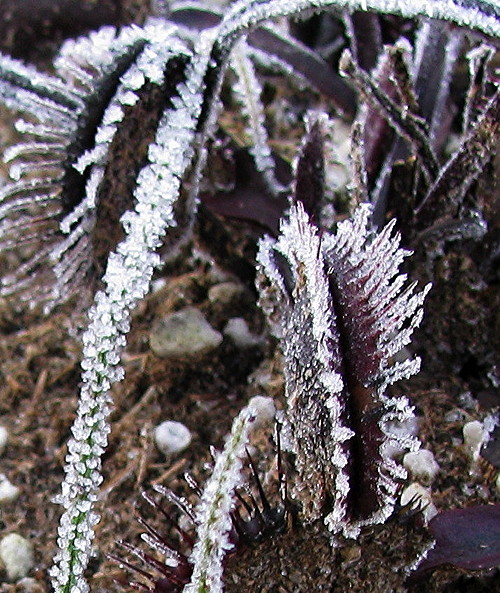
Drosera rotundifolia winter resting bud or hybernacula. This is what this species
looks like a third to half of the year. Keep plants cool
and just damp while in this state.