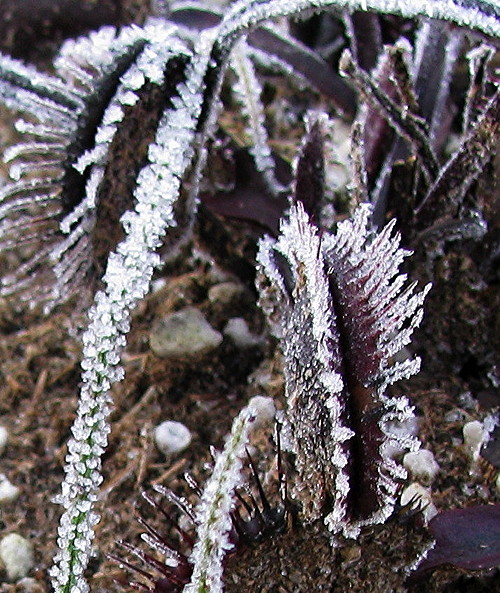
Drosera spatulata from Hong Kong. These plants are about 35 mm wide.
Drosera
spatulata from Hong Kong is one of the easier
D. spatulata varieties and the redder selections have been
given the cultivar name 'Ruby Slippers'.

Drosera spatulata
from Queensland, Australia. This 20 mm wide plant is of the
typical Australian form, only small. It looks a lot like a miniature
Drosera aliciae.

Drosera spatulata var. bakoensis is a variety from Bako National Park, Sarawak, Borneo, Malaysia.
Drosera spatulata var. gympiensis is found near Gympie, Australia. Photo by Ivan Snyder.

Drosera spatulata from Stewart Island, New Zealand. This 20 mm wide plant prefers
cooler conditions as found in its native habitat.
Species of the Drosera spatulata group are found from New
Zealand, Tasmania, and Australia, through southern Asia, and into
China and Japan. This group is in desperate need of taxonomic study.
Depending on your point of view, other species and varieties in the group include
Drosera tokaiensis from Japan, Drosera spatulata var. bakoensis from the Bako National Park, Sarawak, Borneo, Malaysia, Drosera spatulata var. gympiensis found on the Australian coast between Gympie and Fraser Island, Drosera spatulata var. loureirii from Canton, China, and Drosera spatulata var. lovellae found on Fraser Island, Queensland, Australia.
There are a number of chromosomal races currently lumped into
Drosera spatulata. Most New Zealand D. spatulata are diploid with 20 chromosomes. There are a few tetraploid populations with 40 chromosomes in New Zealand. All the other populations of D. spatulata and its varieties are thought to be tetraploid.
Within each chromosomal race there are
plant form
varieties. The
variation
from location
to
location
can
be quite extreme within Australia, Tasmania, and New Zealand. The
smallest forms get to about 2 cm wide. The largest is the 7 cm
wide
Lovellae form found on Fraser Island, Queensland,
Australia. The forms in Australia tend to have long spatulate
(spoon)
to cuneate (cone shaped) leaves with the petiole being short and
graduating into the lamina. New Zealand forms tend to have leaves
with the petiole longer than the lamina with the lamina being orbicular
(round) to cuneate-obovate (flattened oval) although there are populations with the typical Australian form. Tasmania has both
forms.
To make matters even more interesting, there are distinct subtropical,
temperate, and alpine forms.
The species Drosera tokaiensis appears to have resulted
from natural hybridization between Drosera rotundifolia and
the Kanto form of Drosera
spatulata in Japan. Plants may be found that are recent hybrids and are sterile having 30 chromosomes; D. rotundifolia has 20, the Kanto D. spatulata has 40. The typical, fertile D. tokaiensis is an allohexaploid with 60 chromosomes.
| D. tokaiensis is much easier to grow than any of the D.
spatulata varieties and it is quite possible that many
of the D. spatulata seeds distributed by the ICPS Seed
Bank were actually D. tokaiensis. |
The subtropical, tropical, and temperate forms of Drosera spatulata
and its related species and hybrids make excellent additions to
any terrarium keeping in mind there are some warm temperate types that may like it cooler or go dormant and there are some tropical types that may prefer warmer, more humid conditions. In the seed bank, anything listed as plain
Drosera spatulata could be any variety. Known varieties will
be listed when possible. Quite often, the rarer forms are only available
to seed donors.
Drosera spatulata group plants can be started from seed and grown like other subtropical Drosera. The plants can also
be propagated from leaf cuttings when actively growing. Please see Sowing Seeds Step-by-Step for more details on starting seeds, the growing guide Growing Subtropical Drosera for more information on growing them and the Drosera Leaf Cuttings guide to learn about leaf cuttings. A temperature between 20°C
to 25°C (70°F to 80°F) works best for seed germination. Starting plants from leaf cuttings is faster than from seeds. Root cuttings are not usually done with Drosera spatulata because the plants do not have much in the way of roots. Adult plants are best managed if grown in small pots in trays of water.
A happy Drosera spatulata can live for years. The plants
tend to go though cycles of growth and semi-dormancy. When they
bloom, save the seeds to grow more. The seeds can last at least five years if stored in a cool, dry location.
-- John Brittnacher
For more information please see:
Gibson, Robert (1994) Carnivorous plants of New Zealand: A review. Carniv. Pl. Newslett. 23(3):74-81 (
)
Gibson, Robert (1998) Observations on a selection of Tasmanian carnivorous plants. Carniv. Pl. Newslett. 27(3):90-92 (
)
Fleischmann, Andreas and Ch’ien C. Lee (2009) A new variety of Drosera spatulata (Droseraceae) from Sarawak, Borneo. Carniv. Pl. Newslett. 38(1):4-9
Gibson, Robert and Ivan Snyder (2005) Drosera spatulata var. gympiensis: The Formal Description of the 'Hairy Sepal' Taxon from South-Eastern Queensland. Carniv. Pl. Newslett. 34(2):56-60

Drosera tokaiensis (formerly
known as Drosera spatulata "Kansai") is
native to Japan. The largest of the plants in the picture
is 25 mm wide. The plants can get to twice that size.
Drosera tokaiensis is
easy to grow and tends to become a weed. It is common in
CP collections and also commonly misidentified.