|
|
Conservation Grants
Since 2003, the ICPS has financially supported land management work at
carnivorous plant sites in Louisiana, Alabama, Georgia, and two sites in
North Carolina. ICPS grants are directed towards programs that have
demonstrated effectiveness at stewarding sites, to promote their native
carnivorous plants and the biological processes that encourage their
continued presence. Because of this work, ICPS members can take pride in
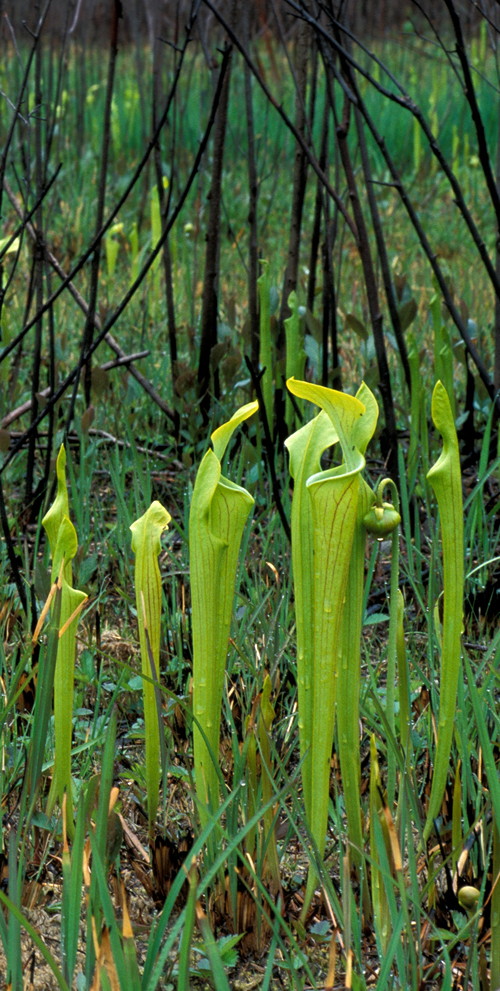
helping maintain homes for species such as Sarracenia jonesii, Sarracenia
alata, Sarracenia psittacina, and at least 15 other species of carnivorous
plants.
|
| ICPS Location Codes - A
New Conservation Initiative
In 2003 the ICPS implemented a short term program to distribute
rare plants that are covered by the US Endangered Species
Act. The ICPS had obtained a permit from the US Fish and Wildlife
Service to proceed with its Sarracenia Distribution
Program. It was our intent to distribute hundreds of plants
within the USA at very low cost to the hobbyist (just a few
dollars per plant). It was the hope of the ICPS that this
plan would reduce poaching of these rare plants.
As many Carnivorous plant enthusiasts, especially Sarracenia
growers, like to know the "location information" or provenance
for their plants, the ICPS conservation program devised the
notion of "ICPS Location Codes." This notion was vetted by
conservation partners of the ICPS, and they all gave their
approval. The ICPS will, under no conditions, reveal the identity
of these locations. However, growers who obtain plants from
these locations via the ICPS will know that they have gotten
plants from separate locations.
The ICPS Location Codes consist of a two letter geographic
code, followed by a sequential three digit number. Within
the USA, the geographic code is the state postal abbreviation.
The three digit number tracks the site within the geographical
region. The ICPS has Location Codes for many sites in the
states of Alabama, Georgia, South Carolina, and North Carolina.
These will be described in ICPS publications and programs
if and when the ICPS obtains seeds or plants it can distribute
by way of this conservation initiative.
Location Codes should not be misinterpreted as cultivar designations.
This means that if you have a plant with an ICPS location
code, do not denote it with singe quotes, as is done with
cultivars :
Sarracenia alabamensis 'AL003'
WRONG
Instead, you indicate provenance information in the same
format that the ICPS seed bank uses, i.e.
Sarracenia alabamensis - AL003
CORRECT
Why did the ICPS do this? Because this program allowed the
horticulturalists to obtain rare plants in a proper and legal
way. This was a win-win situation for all involved:
- Horticulturists benefit because they got plants from different
sites via a reliable source (the ICPS).
- The plants benefit because hopefully there was less need
for irresponsible people to illegally field collect them.
- The ICPS benefits because this project fit perfectly
into its mission of encouraging "Horticulture, conservation,
and science of carnivorous plants."
The ICPS priced plants in its distribution program very inexpensively,
i.e. just to cover costs.
|

AL002 |

AL003 |
Sarracenia alabamensis - 2003 Conservation Program
Release
Below is a description of Location Code sites from which the
ICPS is distributing plants in its conservation program in
2003. The ICPS will, under no conditions, reveal the identity
of these locations. Conservation partners that work with
the ICPS have the assurance that they can cooperate with the
ICPS in helping distribute plants with Location Codes and
that their sites will stay protected and unrevealed. (The
ICPS is fully aware that if it revealed the identities of
the Location Coded sites, it would never be able to hope for
further cooperation with its conservation partners!)
AL001
This is a site in central Alabama that houses Sarracenia
alabamensis. The quality of the site is fairly good, with
many plants that flower vigorously every year. The plants are
growing on the edge of an underground clay dome that squeezes
the water to the surface. This site has a reasonable amount
of topography---the plants are definitely growing on the side
of a hill. The plants tended to be a little on the short side
when I saw them, but might have been because the year was very
dry. The plants grew among many pine trees, and as a result
were a little etiolated in places.
AL002
This is a small, flat site in central Alabama that houses Sarracenia
alabamensis. The site has a good supply of water (there
is even a nicely snake-infested stream nearby), but it is enclosed
on all sides by dense vegetation (both native and non-native).
With just a few years of neglect, the vegetation could close
in on the site. Fortunately, the owners burn the site regularly
so this is not (as yet) a problem. The plants at this site are
different from the others I have seen in that they tend to form
dense clusters of pitchers---each clump is about 60 cm (2 feet)
in diameter. The photo to the right shows a single clump early
in the season---many dead pitchers from the previous year are
still visible.
AL003
This is a large, very gently sloping site in central Alabama
that houses Sarracenia alabamensis. The quality of the
site is the best I had ever seen---the plants were growing in
full sun with plenty of strong light and plentiful water which
was squeezed to the surface by an underground clay dome (even
during a drought year that I saw it). The plants are really
beautiful.
|
Sarracenia purpurea var. montana recovery initiatives
Sarracenia purpurea var. montana is a rare pitcher
plant found only in a few bogs in the Appalachian mountains.
This plant is in particular peril because of ecosystem-wide
threats of changes in the hydrology, fire suppression, and
development. The ICPS is helping fund a restoration project
at the only Sarracenia purpurea var. montana
bog remaining in Georgia. The work, being implemented by staff
of Atlanta Botanical Gardens, will increase the one relict
population to a viable network of several bogs.
See our profile Sarracenia purpurea
var. montana - Success Story
|
Darlingtonia californica Stewardship
The ICPS has been closely involved in the protection of a
Darlingtonia site in Nevada County, California. It
has been observed by one ICPS botanist that the alders have
been encroaching on this bog, possibly as a result of fire
suppression. While fire is an unworkable stewardship solution
in this area of California, manual thinning and removal of
some of the alders should have a rejuvenating effect on the
site. The ICPS is working to obtain permission to begin alder
removal at the site.
Other Darlingtonia sites in northern California have
been suffering from encroachment of woody species and invasive
non-natives such as broom (Cytisus scoparius). After
a survey of the sites is complete, management proposals will
be made and the ICPS hopes to develop a management program
with the US Forest Service (which owns a number of the Darlingtonia
sites).
See our profile "A Cobra Lily
Success Story"
|
Sarracenia manager meetings
All the erect species of Sarracenia are located in
the southeastern coastal regions of the USA except for three
species. This trio, Sarracenia alabamensis, Sarracenia
jonesii, and Sarracenia oreophila are found in
the mountains of Alabama, Georgia, and the Carolinas. All
three are extremely rare and, while protected by the Endangered
Species Act, are threatened by habitat degradation and poaching.
It is important for land managers who steward the mountain
bogs to stay in communication with each other so they can
share information on techniques and best practices. The ICPS
funded a meeting for the first-ever such event, which took
place in late August, 2000, and concentrated on Sarracenia
oreophila.
This project is profiled as one of our "Success
Stories".
|
Nepenthes clipeata Survival Program
One of the rarest of the tropical pitcher plants, Nepenthes
clipeata is only found on vertical cliff faces of Gunung
Kelam, in Kalimantan Barat. Droughts, human habitat destruction,
and high levels of poaching have reduced the plant population
to shreds. The plant has a low probabability of surviving
for even 20 years.
The ICPS is organizing a network of botanical gardens and
tissue culture labs which have clones of Nepenthes clipeata
in cultivation. We will be attempting to determine how many
distinct lineages of Nepenthes clipeata are presently
in cultivation. While the ICPS strongly promotes protection
of wild populations of plants, this is a case in which ex
situ conservation is the approach most likely to be successful
and realistic.
|
|
|