|
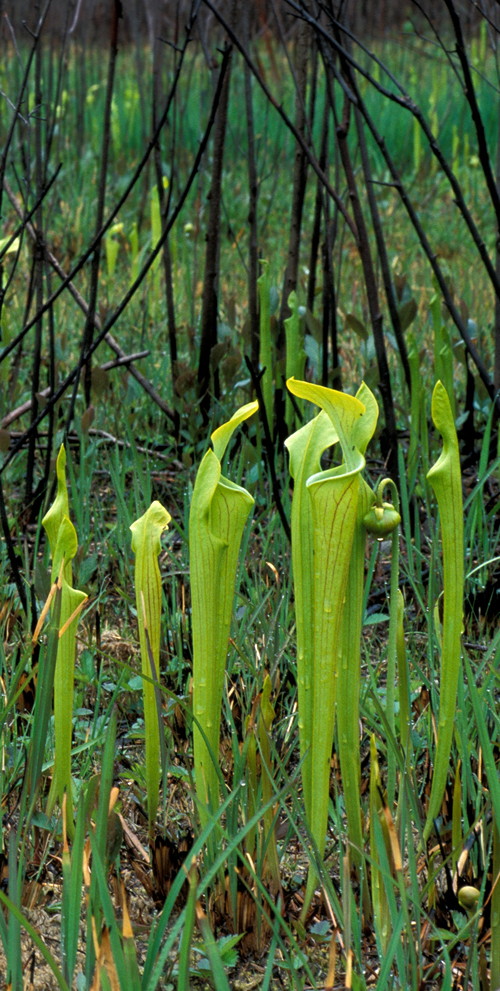
Darlingtonia californica is a carnivorous plant found
only in northern California and western Oregon. This plant is famous
for how its leaves resemble an enraged, striking cobra (hence its
common name: cobra lily). High in the Sierra Nevada of Nevada County,
California, there is a cobra lily wetland that is particularly special
for two reasons. First, it is the farthest-south site that exists
for this species. Second, it is at this wetland and this wetland
alone that a mutant form of cobra lily exists which has yellow flowers
(instead of the normal red-flowered form).
In 1997, the ICPS learned that the owners of this site, who had
carefully managed it for many years to preserve its natural value,
had sold the parcel that contained the wetland. The new owners were
interested in only one thing--logging the site to make as much money
as they could. This immediately imperiled the cobra lilies because
if even one large tree was felled into the wetland and then dragged
out, the ripping damage to the delicate soil structure in the wetland
could be extreme---it might even create a drainage channel that
would kill all the plants!
By the time the ICPS learned about the proposed timber plan, it
was already under review at the California Department of Forestry.
There was no time to lose! Members of the ICPS around the world
were mobilized to write letters and faxes to the Department of Forestry.
The protest to the timber harvest plan completely surprised the
Department of Forestry, and they were happy to work with recommendations
provided by the ICPS, the Nevada County Conservation Alliance, and
the California Native Plant Society. A biologist from the ICPS also
met with the new landowner and his forester, and explained the value
of the wetland. Soon the owner was a willing partner in protecting
the site, and a voluntary 100 foot harvest and equipment-free buffer
zone of white fir forest was set adopted while the surrounding land
was timbered.
After the logging operation was completed, the landowner
sold the parcel yet again, but this time the timber rights were
purchased using grant funds from The Nature Conservancy. The site
is now protected from logging in perpetuity because of this conservation
easement. Two biologists, one being the ICPS's Dr. Barry Meyers-Rice,
are listed in the site's Conservation Easement Management Plan as
being given continued access to the location for future study.
|